
Paul Mifsud on what makes fund business stay in Malta
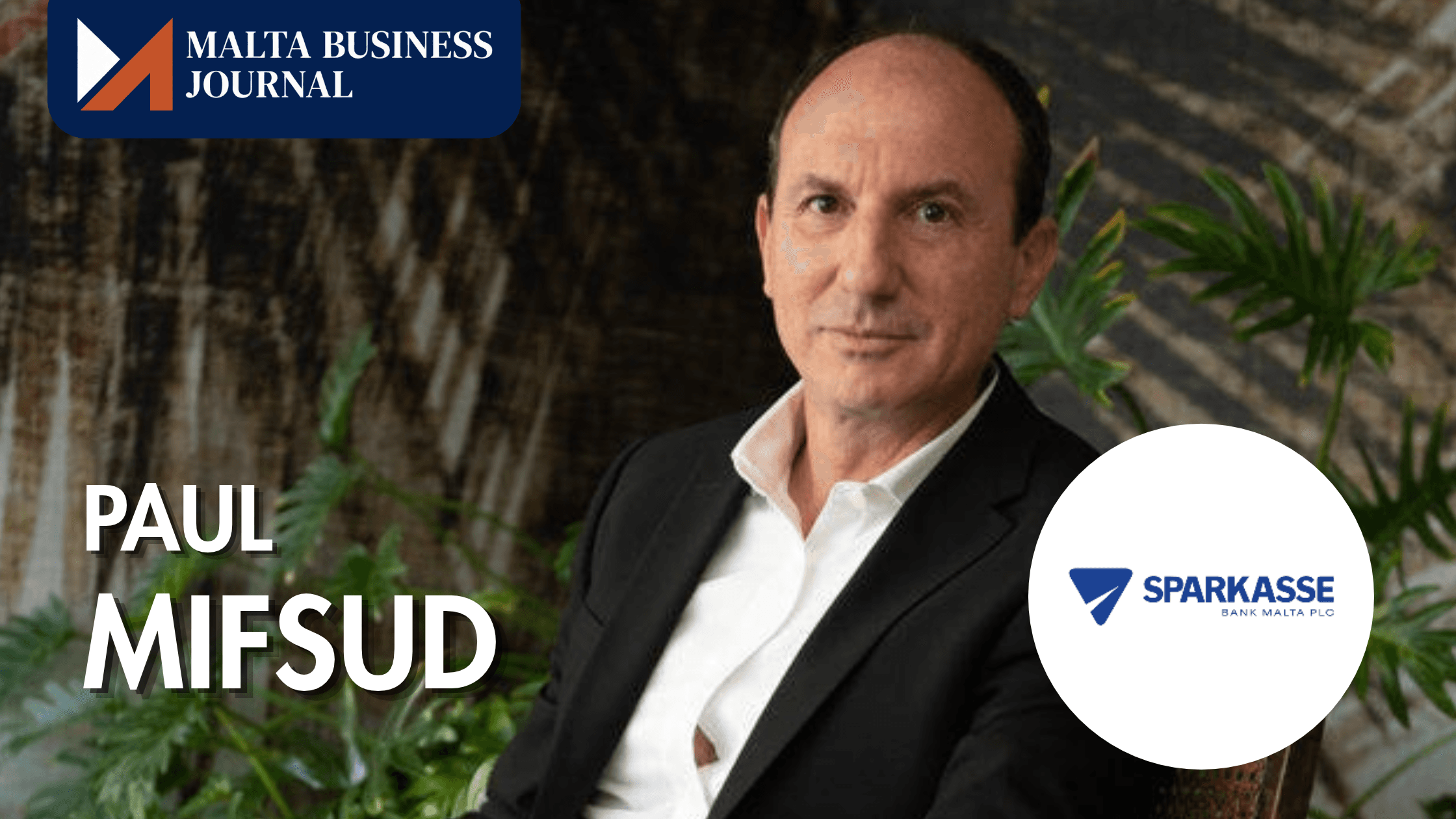
Sparkasse Bank Malta’s Paul Mifsud explains what private clients and investment managers expect from specialist banking, why custody and depositary services matter, and how Malta can build the expertise that persuades international fund business to stay.
Winning an international fund manager’s business is the beginning of a much longer test. For Paul Mifsud, the question is whether Malta can keep providing the expertise and dependable service that allow that business to grow here.
In this MBJ 1:1 interview, the Managing Director of Sparkasse Bank Malta discusses the banking relationships and fund services that support investor confidence. His argument for Malta’s future centres on developing the specialist knowledge needed to sustain those relationships.
Understanding the client behind the transaction
We begin with what private clients and investment managers expect from a specialist bank, and why Mifsud puts understanding their circumstances at the centre of that relationship.
“The fundamental difference is that specialist clients are not simply looking for a bank to execute transactions. They are looking for a partner that understands the complexity of their financial affairs and can support them as their needs evolve.
“For private clients, this means a more holistic approach to wealth: combining banking, investment services, custody, liquidity management and, where appropriate, credit facilities within a coherent relationship. They expect discretion, responsiveness and access to people who understand their circumstances and can provide informed guidance.
“Investment managers and regulated financial institutions have a different, although equally demanding, set of priorities. They require operational reliability, robust controls, accurate reporting and a banking partner that understands the regulatory and transactional demands of their business. In this environment, a delayed settlement or an inefficient process can have consequences well beyond the immediate transaction.
“At Sparkasse Bank Malta, we believe the value of a specialist bank lies in combining technical expertise with accessibility and sound judgement. Technology is essential, but it cannot replace experience or personal accountability. Ultimately, clients want a bank that understands their business, anticipates their needs and delivers consistently. That is the standard against which specialist banking should be measured.”
The controls that support investor confidence
Asked to distinguish custody from the wider responsibilities of a depositary, he explains how both services support investor confidence.
“Custody and depositary services are fundamental to the integrity of the investment management industry. Investors need confidence not only in the investment decisions being made, but also in the arrangements protecting their assets and the controls governing the fund in which they invest.
“Custody is primarily concerned with the safekeeping and administration of financial assets, together with the associated record-keeping, settlement and corporate actions. Assets must be properly identified, reconciled and protected in accordance with the applicable regulatory requirements.
“Depositary services have a broader regulatory dimension. Depending on the type of fund and the applicable framework, the depositary's responsibilities include safekeeping or verifying ownership of assets, monitoring cash flows and performing oversight functions. These responsibilities provide an important additional layer of control within the fund structure.
“The distinction matters because a depositary is not simply a custodian under another name. Its role extends beyond holding assets to fulfilling specific regulatory responsibilities designed to support investor protection and the proper functioning of the fund.
“Neither function eliminates investment risk, nor should either be mistaken for a guarantee of investment performance. Their value lies in the discipline, transparency and independent controls they bring to the structure.
“For a specialist bank, these are responsibilities that demand investment in systems, experienced professionals and rigorous processes. Much of this work takes place behind the scenes, but it is precisely this consistency that helps sustain confidence in the wider financial system.”
Why managers choose Malta and stay
The discussion turns to Malta and the experience a manager has after establishing a business, when service and support for growth are tested.
“Malta has several important advantages: membership of the European Union, an established financial services framework, a network of professional service providers and a jurisdiction where decision-makers can often access the people they need without the layers of complexity associated with larger financial centres.
“However, the decision to establish a business here is only the beginning. The more important question is whether the jurisdiction can support that business effectively over the long term.
“International managers look at the clarity and predictability of the regulatory environment, the availability of experienced talent, the quality of legal, audit and fund administration services, and the efficiency with which they can establish their operations. Access to dependable banking, custody and depositary services is also an important practical consideration.
“Once a business is established, retention depends on the quality of the experience. Managers need timely responses, consistent service standards, clear communication and confidence that their service providers can accommodate growth without compromising controls. They also need a jurisdiction that continues to invest in its capabilities as regulatory expectations and investment strategies evolve. The focus here should be built around expertise, accessibility, reliability and the ability to provide a coherent ecosystem of services. Ultimately, international managers will remain where they can run their businesses effectively, meet their obligations and build for the future with confidence.”
Building the expertise to support growth
Malta’s compact market can make expertise easier to reach. Mifsud also identifies gaps that become more pressing as investment strategies grow more complex.
“One of Malta’s strengths is the concentration of expertise within a relatively compact market. Fund managers, administrators, lawyers, auditors, compliance professionals, banks and regulators operate within an environment where communication and access can be direct. This can make a meaningful difference when a business needs to resolve an issue or develop a new structure.
“Malta has also built experience across different fund structures and investment strategies, supported by its European regulatory framework. The opportunity is to build on that foundation and demonstrate that a smaller jurisdiction can deliver sophisticated services to international standards.
“There are, however, areas where further progress is needed. Specialist expertise is not equally available across every asset class, and a relatively small talent pool can make it difficult to scale certain capabilities quickly. As investment strategies become more complex, the market needs deeper expertise in areas such as private markets, asset valuation, risk management, technology and the operational requirements of newer investment structures.
“I would not characterise these challenges as unique to Malta, but they are particularly important for a jurisdiction of our size. We need to continue investing in skills, infrastructure and collaboration, while ensuring that innovation is matched by appropriate governance. Our objective should not simply be to attract more business, but to develop the depth of expertise that encourages high-quality business to stay and grow here.”
Making onboarding work better
That concern with expertise shapes his approach to onboarding, where clear communication and better systems can improve efficiency and understanding of the client.
“Efficiency and sound risk management should reinforce one another. The objective is not to reduce the depth of due diligence, but to make the process more proportionate.
“That begins with understanding the client and the proposed business early. Clear communication about documentation, ownership structures, source of funds, expected transaction activity and regulatory requirements helps avoid unnecessary delays later. Clients should know what is required, why it is required and who is responsible for moving the process forward.
“Technology can make a substantial contribution through digital document collection, workflow management, data integration and automated checks. It can reduce duplication, improve consistency and give relationship teams more time to focus on matters that require professional judgement. However, automation should support the decision-making process rather than replace accountability.
“The same principle applies after onboarding. Ongoing monitoring should reflect the nature of the relationship, the risks involved and changes in the client's circumstances or activities. A specialist bank needs systems that identify relevant developments promptly, but it also needs experienced people capable of interpreting those developments in context.
“At Sparkasse, we see specialist knowledge and personal service as important complements to operational efficiency. A relationship manager who understands the client's business can help identify issues early and coordinate the right expertise internally.
“Ultimately, good onboarding should not be measured solely by how quickly an account is opened. It should be measured by whether the bank has developed a sufficiently clear understanding of the client to manage the relationship responsibly from the outset.”
Assessing new assets on their substance
As clients explore new assets and structures, he sets out how the bank assesses what it has the capability to support.
“Our starting point is that innovation should be assessed on its substance, rather than its popularity. A new asset class or investment structure may present a genuine commercial opportunity, but that does not automatically mean it is appropriate for a particular bank to support.
“We consider several questions. Do we understand the underlying asset and the legal rights attached to it? Is the regulatory framework sufficiently clear? Can ownership be verified, assets safeguarded and transactions settled reliably? Are valuation, liquidity, counterparty and operational risks properly understood? And do we have the systems, expertise and controls necessary to manage those risks over the life of the relationship?
“These questions become particularly important when dealing with assets that do not fit conventional custody models, or structures that introduce new technological, legal or operational dependencies. Digital assets are one example of an area where the pace of innovation makes a disciplined assessment especially important.
“There is a distinction between being open to innovation and pursuing it indiscriminately. A specialist bank should be prepared to develop its capabilities where there is a clear client need, a viable business case and a risk framework that the institution can confidently support.
“Our role is to support clients pursue legitimate opportunities within a framework of sound governance. Sustainable growth depends on knowing not only where we can compete, but also where the risks fall outside our expertise or appetite.”
Choosing where Malta can excel
Looking towards 2027, Mifsud wants Malta to become recognised for particular areas of excellence and to remain attractive to professionals choosing where to work and live.
“Malta has a lot to offer where the more critical ingredients are already in play such as our strong regulatory framework, EU membership and our geographical location and language. What we should focus on next is to optimise on a few areas of excellence and receive the recognition as being best of breed in a few but solid niche services. ‘’Less is more’’ and quality should also be a priority over quantity with a strong bias on preserving the environment and making the country a top spot for work life balance for professionals.”