
WSC's €60m Ħal Far plant to double Malta's desalination capacity
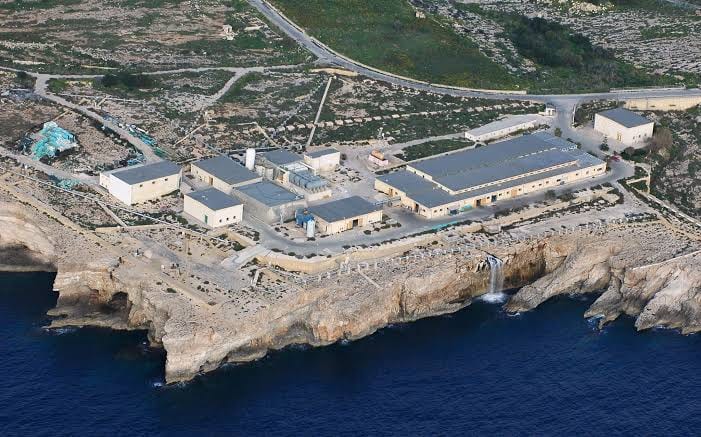
The Water Services Corporation plans a €60 million reverse osmosis plant at Ħal Far, more than doubling Malta's installed desalination capacity to 212,700 cubic metres daily.
The Water Services Corporation is planning a €60 million reverse osmosis plant at Ħal Far, adding 40,000 cubic metres of drinking water production capacity a day as part of a wider programme to strengthen Malta’s water supply.
The project announced by the government is intended to help meet demand over the next two decades. Alongside upgrades to existing facilities, the programme aims to bring national water production capacity to approximately 200,000 cubic metres daily by 2030.
The proposed facility will be the fifth reverse osmosis plant serving Malta and Gozo, joining those at Pembroke, Għar Lapsi, Ċirkewwa and Ħondoq.
Energy and Environment Minister Miriam Dalli said the investment would prepare essential infrastructure for future needs and support a consistent supply for households and businesses.
Distribution is a central part of the project. Approximately nine kilometres of twin pipelines, each 700mm in diameter, will connect Ħal Far to the Qrendi reservoir, allowing additional production to feed into the southern network.
WSC says the expanded system will provide sufficient spare capacity to maintain supplies when any one of its five production plants is offline for maintenance, refurbishment or an unexpected shutdown.
The plans follow earlier investment in Malta’s water distribution network, where upgrades have focused on renewing infrastructure and reducing losses.
Malta’s dependence on desalination is already substantial. According to WSC’s 2025 annual report, reverse osmosis supplied 70.7% of potable water production that year. Groundwater production stood at approximately 11.5 million cubic metres.
The corporation linked the higher proportion of desalinated water to lower salinity at customers’ taps. Reducing groundwater extraction also eases pressure on underground reserves.
That shift carries an energy cost. Across its operations, WSC consumed approximately 190 million kilowatt-hours of electricity in 2025, with desalination accounting for most consumption. Its electricity costs reached €20.1 million. These are corporation-wide figures, rather than costs attributable solely to reverse osmosis.
Preparatory work at Ħal Far included drilling a 120-metre-deep seawater borehole near the coastal cliff edge. The government says preliminary investigations confirmed suitable geological conditions, with surrounding rock acting as a natural filter before seawater reaches the treatment membranes.
The coastal setting also makes construction impacts, lighting and effects on the surrounding environment relevant considerations as the proposal progresses.
The project includes storage reservoirs, offices, a central control room and connections to the national distribution system. Commissioning is targeted for 2030.
For Malta’s business community, greater water resilience supports continuity in manufacturing, hospitality and other activities dependent on reliable supplies. The longer-term commercial value will also depend on efficient energy use, effective distribution and the delivery of the planned capacity.