
Heritage Malta drives Europe's largest digital heritage conference
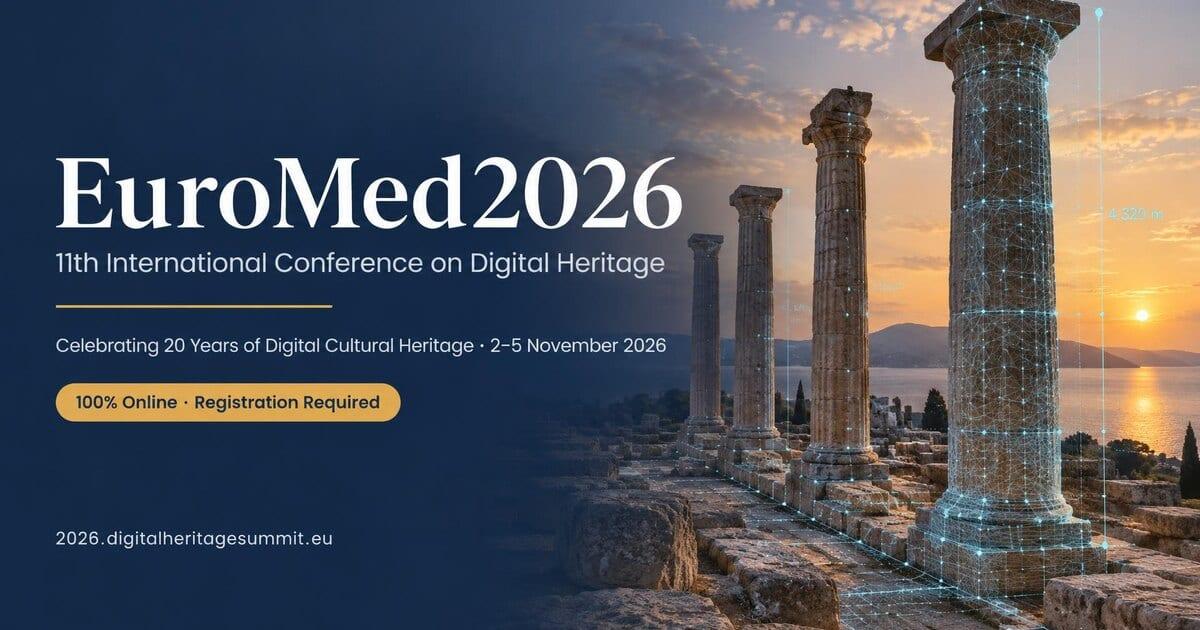
Heritage Malta led EuroMed2026, attracting 800+ registrations and 234 academic contributions, showcasing the Memory Twin concept.
Heritage Malta was the driving force behind EuroMed2026, Europe's largest digital cultural heritage conference, held virtually from 2 to 4 November.
The event marked the conference's 20th anniversary and drew strong international interest, attracting 234 academic contributions and more than 800 registrations.
Since 2006, the Euro-Mediterranean Conference on Digital Cultural Heritage has brought together researchers, cultural heritage professionals, museums, technology experts, industry representatives, educators and policymakers from around the world.
Over three days, the conference explored topics ranging from conservation, collections and research to interpretation, education, public engagement, and the safeguarding and management of cultural heritage.
In his opening address, Heritage Malta CEO Noel Zammit highlighted the agency's initiatives, including the Memory Twin concept, while emphasising that all digital progress must ultimately serve people.
“The success of digitisation should not only be measured by how many objects we scan and the sophistication of our technology, but also by whether, through digitisation, more people can discover their heritage, researchers can ask new questions about it, educators can use it, future generations can trust it, and communities can continue to recognise themselves within it,”
The opening keynote was delivered by David Frank Bugeja, Senior Conservator at Heritage Malta's conservation laboratories. Drawing on two artworks exhibited at MUŻA, he demonstrated how collaboration between different experts can uncover hidden histories, inform conservation decisions and reconnect objects with contexts they had lost.
Anthony Cassar, Head of Heritage Malta's Technology and Experience Development Unit, served as one of the Conference Chairs. In the first workshop, he presented Malta's first Memory Twin implementation, based on the Malta Dockyard Collection and other Heritage Malta collections.
He demonstrated how digitised objects merge physical heritage, archives, people, places, traditional skills, oral histories and community memories in a living, traceable digital framework. He then moderated the second workshop, which convened leading 3D digitisation technology providers to explore current technologies' limitations and opportunities.
For Malta's business community, this positions the island as a serious player in the digital heritage space, opening doors for local tech firms and researchers to collaborate on EU-funded projects and commercial applications.
In view of the unprecedented response and the exceptional scientific quality of the submissions, the 20th anniversary celebrations will continue with EuroMed2026 – Part II in February 2027, hosted virtually by the University of Cambridge, United Kingdom. Registration and participation will once again be free of charge. Both parts of the conference will be brought together in a single scientific publication.