
Matthew Bezzina on why technology has to earn its place
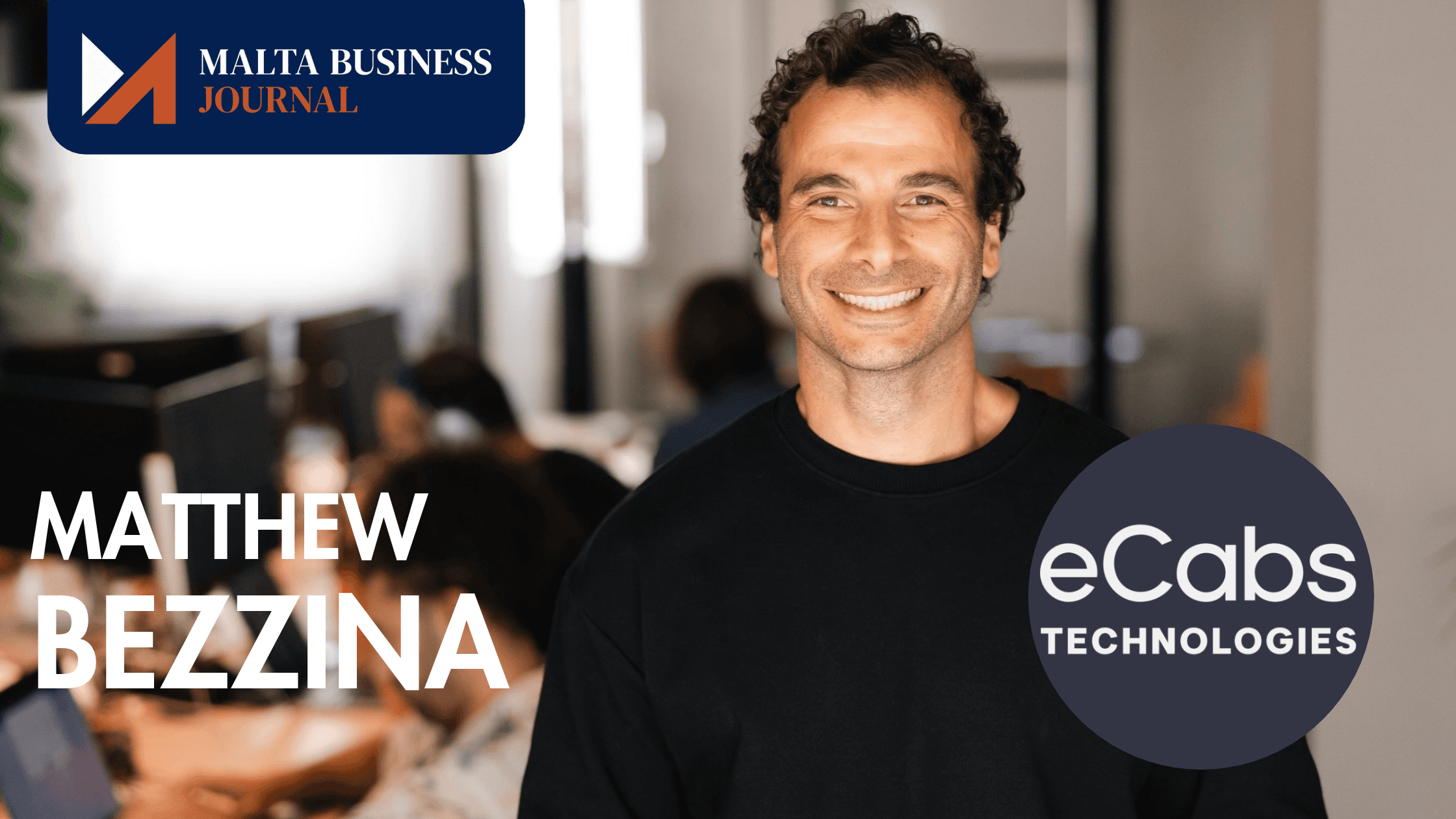
Matthew Bezzina, CEO and co-founder of eCabs Technologies, explains how Malta shapes mobility software for international markets, what businesses should demand from AI and why management remains accountable when automation fails.
When eCabs first released a tool to update flight information for airport pre-bookings, its Malta operations team had to return to doing the work manually. The initial release had failed. Within around six weeks, Matthew Bezzina says, colleagues across operations, product and engineering had turned it into a working tool.
For the CEO and co-founder of eCabs Technologies, the experience explains why a system must justify its place in the business, and why management owns the consequences when it fails.
In this MBJ 1:1 interview, Bezzina connects lessons from Malta’s taxi operation with the challenges of building software for international markets and the decisions facing businesses in 2027.
What Malta teaches a mobility business
Asked what Malta can teach a mobility technology business seeking to compete abroad, Bezzina returns to the experience of running the service.
“Malta forces you to understand the whole operation. You cannot build a taxi or ride-hailing business here without dealing with seasonality, tourism, traffic, driver availability, customer expectations and tight margins. Those pressures have grown considerably. By the end of 2025, Malta’s population had reached 588,254, up 2.4% in a year, while annual tourist arrivals exceeded four million, an increase of 12.9%. That is a lot of additional demand on a small road network.
“TomTom’s Traffic Index ranked Malta as the second most congested country globally in 2025, behind Colombia. For us, that makes Malta an ideal testing ground for transport technology: a compact market where demand, congestion and operational complexity put your systems under constant pressure. You quickly discover whether your arrival estimates are accurate, your dispatch works and your technology helps drivers spend more time carrying passengers and less time driving empty.
“We founded eCabs in 2010 and have been competing with global platforms since 2017, while navigating constantly changing regulation. That uncertainty is a headache for any business trying to plan, invest and grow. Before building technology for other operators, we spent years running the service ourselves. We have taken the calls, managed the drivers, dealt with peak demand and carried the cost when something went wrong.
“We have also gone through multiple technology migrations ourselves, so we understand the anxiety of changing the system your entire business depends on while keeping a round-the-clock service running. Moving the data is only part of it. You need dispatchers to trust the new system, drivers to adapt and customers to continue getting the service they expect. That experience matters when we ask another operator to trust us with their business.
“That combination of engineering and operational knowledge shapes eCabs Technologies. We understand why a dispatcher needs to complete a booking in seconds, why drivers reject work and why a technically successful release can still fail commercially. Having the Malta operation alongside us means we can test technology in everyday conditions and see the consequences first-hand.
“The capability we take abroad is that ability to connect technology with operational and commercial reality. Every market has its own regulations, working practices and customer expectations, so we bring our experience while listening carefully to the people running the local business.”
Turning data into decisions customers can trust
The discussion turns to data and customer trust. Bezzina focuses on how information improves the service, and the responsibilities that come with collecting it.
“Taxi and ride-hailing operators sit on a rich source of data. Across our platform, we generate millions of data points every day, from customers opening an app and requesting a price to drivers accepting work and completing journeys. The opportunity is turning those signals into better decisions.
“I often compare it to the oil industry. Having oil underground is only the starting point. You need the infrastructure to extract it, refine it and get it somewhere it can be used. Data requires a similar investment. You can collect it, organise it neatly in a data warehouse and still get very little value from it. You need reliable information, the right tools and people who understand how to interpret it and act on it.
“In our business, that means anticipating demand, positioning vehicles more effectively and reducing the time drivers spend empty. Customers benefit through shorter waits, more accurate arrival times and fewer cancellations. Drivers benefit through more productive working hours.
“Our recently released surge pricing tool is one example. It combines historical demand with live signals, including driver availability and customers opening the rider app, to help pricing respond to demand and available supply. Customer trust requires the fare to be clear before booking, while operators need controls over how pricing behaves.
“That trust also depends on how we handle the underlying information. Location and travel history are sensitive. All our platform data is encrypted and hosted on Google Cloud infrastructure, with its own security controls and monitoring. Alongside those protections, we have a responsibility to restrict access and be clear about how information is used.
“For our city partners, ownership and control of their data are fundamental. They have spent years building their customer and driver relationships. Our role is to give them the tools to make better use of that knowledge while protecting those relationships and preserving their independence.”
What survives the move into another market
That operational perspective also shapes the question of international growth. A platform has to accommodate the details that determine whether a local operator can use it commercially, while retaining a common product.
“For us, the principle is roughly 80:20. Around 80% of the product serves needs shared by taxi and ride-hailing operators everywhere: bookings, dispatch, rider and driver apps, corporate accounts and reporting. The remaining 20% is about adapting to the city partner and their market.
“That 20% can determine whether the platform is commercially usable. It includes local regulations, pricing structures, payment providers, taximeters, telephony and accounting requirements. Translating an app and changing the currency is only a small part of entering a new market.
“Our approach puts one core platform at the centre, connected to the systems an operator needs around it. A German taxi business may require particular taximeter and fiscal integrations, while a partner elsewhere needs a local payment provider or a different telephone setup. APIs allow us to connect those systems while continuing to develop a common product.
“That is where scalability comes from. Improvements to the shared core can benefit partners across markets, while local integrations make the platform work for each business. Over time, an integration developed for one partner can also open the door to others with similar requirements.
“You also have to deliver the migration and bring people with you. We have gone through multiple migrations ourselves, so we understand that dispatchers and drivers need confidence in the system from day one. The service has to keep running throughout.
“The real test is whether you can repeat this across markets without rebuilding the business each time. You need enough consistency to scale and enough flexibility to respect how each local operator works.”
The evidence behind an AI investment
Asked what should justify taking an AI pilot into everyday operations, Bezzina starts with the improvement the business can demonstrate.
“You need evidence that it improves the business under real operating conditions. A good demonstration gets my attention, but before expanding it I want to understand what improved, how consistently and at what total cost.
“Take voice AI for telephone bookings. Answering thousands of calls sounds impressive. But did it understand the pickup address, create the right booking and recognise when the customer needed a person? If staff spend their time correcting mistakes or customers have to call again, the headline number tells you very little.
“The same applies to automated pricing. You need to assess the effect on completed journeys, customer conversion, driver earnings and margin. Higher prices alone do not prove that the system is making better decisions.
“That means establishing a baseline before the pilot and measuring against it across busy periods, quieter hours and difficult cases. You also have to count the full cost: integration, ongoing usage, supervision and the work needed to resolve errors. Time saved only becomes a return when the business puts that capacity to productive use.
“Our Malta operation is always the guinea pig. We test new capabilities in our own business first, carry the operational consequences ourselves and use that experience to improve them before rolling them out to city partners. The people taking the calls, managing the drivers and serving customers tell us very quickly whether something works. That keeps us honest.
“I would expand when the improvement is consistent, the economics justify it and the team can monitor and intervene effectively. A pilot should have clear success criteria and a decision date. If it meets them, commit. If it falls short, fix it or stop it.”
Accountability when automation fails
The question of performance leads to a harder one: who owns a poor outcome once a system has been deployed? Bezzina’s answer leaves management with a direct obligation to the customer.
“The people running the business remain accountable. You cannot deploy a system that affects customers or drivers and then hide behind “the algorithm decided”. The customer’s relationship is with your business, and they expect you to resolve the problem.
“There needs to be a named owner, with clear responsibilities across product, engineering and operations. But accountability also means getting those teams working together to turn a poor outcome into a successful product. The close relationship between eCabs Malta and eCabs Technologies helps us do that. We also have former eCabs Malta operations colleagues now working in quality assurance and product at eCabs Technologies. They bring first-hand knowledge of the operation into how we design and test the technology, and understand what happens on the ground when something fails.
“We recently released a tool that automatically updates flight information for airport pre-bookings in our central system, wherever a city partner operates. The first release was a complete failure. Our Malta operations team went back to updating flights manually to protect the service, while product and engineering worked through the problems with their input.
“We kept ownership of the problem and worked through it. Within around six weeks, thanks to the contribution of people across both businesses, the tool was working like a Swiss clock.
“That experience captures what accountability should look like: acknowledge the failure, protect the customer, give people the authority to intervene and follow through until the problem is resolved. Whether a system uses AI or another form of automation, management remains responsible for the outcome.”
The value of understanding the whole business
The interview turns to the skills employees need to work effectively with AI. Bezzina draws on colleagues who have moved between operational and technical roles.
“The biggest shift, in my view, is moving beyond narrow specialisation towards understanding how the whole business works. As AI takes on more specialist tasks, I believe greater value will sit with people who can connect technology, operations, finance, customer behaviour and competition, and understand how a decision in one area affects the others.
“You can be excellent at writing code, but if you have no understanding of how the business makes money, what customers need or how competitors are changing the market, you can build something technically impressive that achieves very little. Technical depth still matters. Its value grows when you know where to apply it and why.
“At eCabs Technologies, I want engineers to understand what happens when a driver rejects a journey, why a dispatcher needs to save seconds on a booking and how a pricing decision affects both demand and earnings. Equally, operational and commercial teams need to understand what technology can do and how to assess its results. That shared understanding helps people make better decisions together.
“Our colleagues who moved from eCabs Malta operations into product and quality assurance are a good example. They bring practical experience into technical discussions and can connect what appears on a screen with what happens on the road.
“Organisations need to develop that breadth deliberately: expose people to other departments, involve them in commercial discussions and give them responsibility for outcomes beyond their own task. Alongside that, employees need to learn how to question AI outputs, interpret data and recognise when an answer misses the wider context.
“The ability to join the dots, exercise judgement and turn knowledge into a sound business decision will, I believe, be among the most valuable skills of the future.”
Choosing a problem worth solving in 2027
Asked where a business seeking measurable technology results should begin in 2027, Bezzina returns to the operating problem and the people responsible for fixing it.
“Start by choosing one recurring problem that is costing your business money, time or customers, and establish what it costs you today. You need that baseline before you can judge whether an investment has worked.
“In a taxi or ride-hailing operation, that might be the amount of time vehicles spend empty. Before adding more cars or drivers, understand why the capacity you already have is not being used effectively. Is it poor allocation, long pickup distances, unnecessary waiting or a mismatch between shifts and demand? Each cause requires a different response.
“Put the people who understand the operation, the technology and the finances around the same table. Give one person ownership, agree what success looks like and set a deadline to assess it. That could mean fewer manual interventions, a lower cost per completed booking or more productive vehicle hours, while maintaining service quality.
“Then choose the technology that helps you achieve that outcome. AI may allow you to deliver something faster or tackle a problem that was previously too expensive to solve. But the investment still needs to stand up commercially, including the cost of implementation, supervision and ongoing use.
“The final step is acting on what you learn. A dashboard showing inefficiency achieves nothing if nobody changes the way the business operates. Hours saved have value when you use them to serve more customers, improve quality or reduce cost.
“My advice for 2027 is to start with a problem you can measure, give a team responsibility for solving it and follow through until the improvement shows up in the business.”